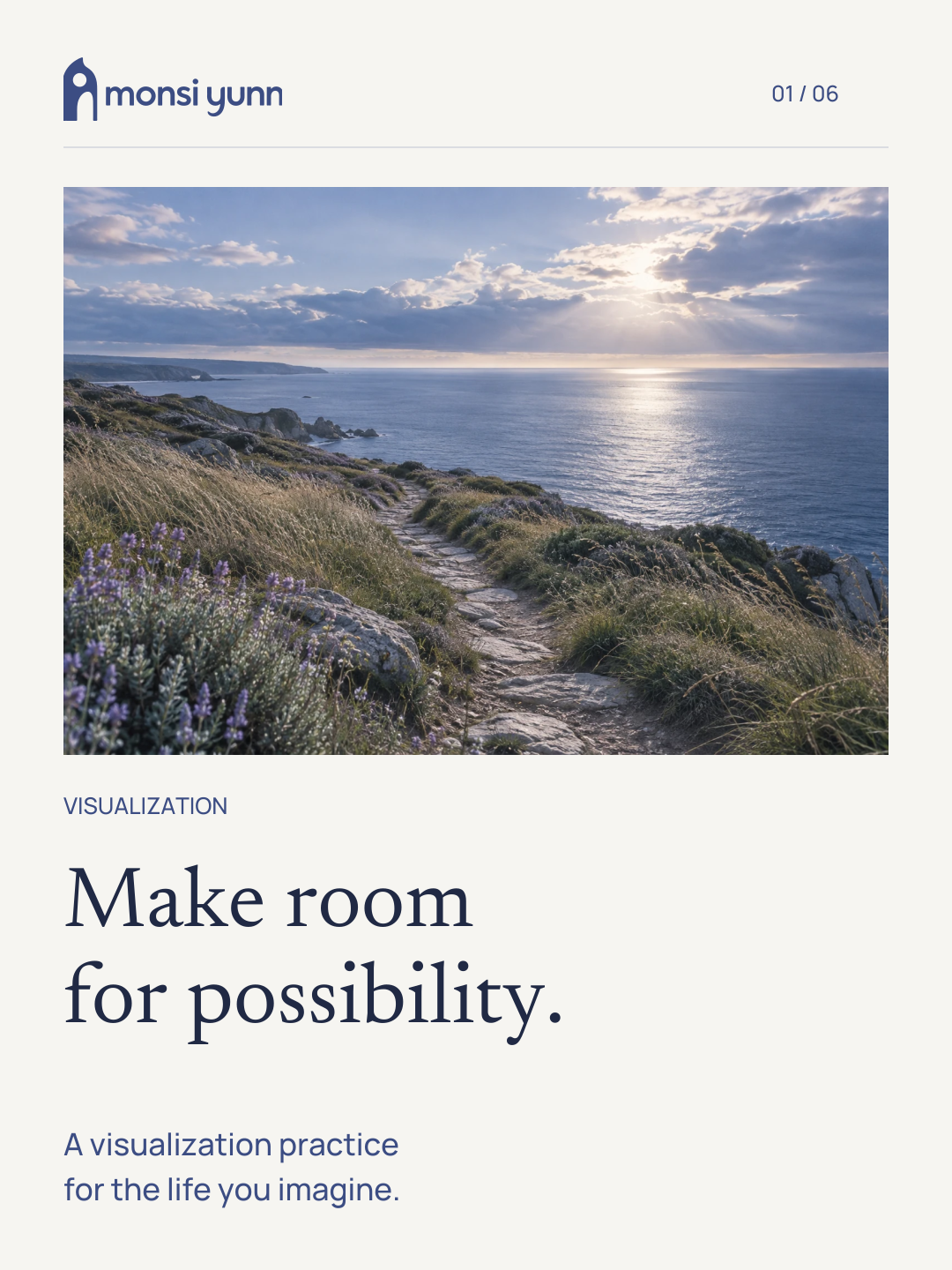
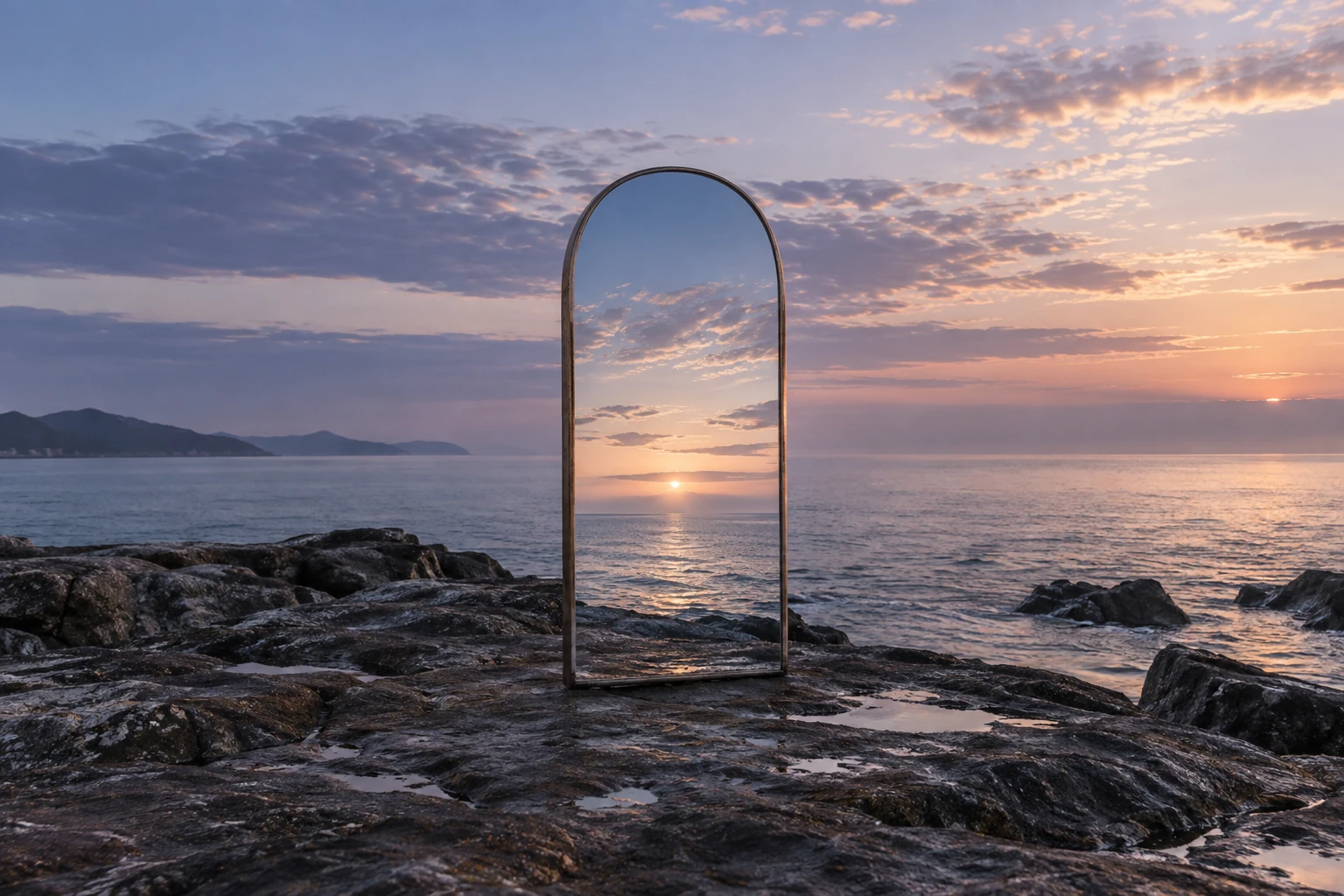
There is a particular kind of hope in imagining a different life. You see a room you would love to wake up in, work that feels meaningful, or a version of yourself who moves through the day with more courage. Stay with that image for a moment. What is it really asking for?
Look beneath the picture
The first image is often beautiful and a little distant. A home beside the sea. A thriving business. A life that looks peaceful from the outside. Rather than dismissing it or treating every detail as a requirement, ask what draws you to it.
Perhaps the sea represents space to think. Perhaps the business represents independence or the wish to make something useful. Perhaps the peaceful life is really a longing to feel less hurried. Naming the quality beneath the picture gives your imagination something you can work with today.
Write a sentence beginning, “What I want to feel or make room for is…” Take your time. You may discover that the thing you need is simpler, deeper, or different from the image you began with.
Imagine an ordinary day inside that life
Choose a scene small enough to enter. An ordinary morning may tell you more than an imagined moment of triumph. Where are you? What are you paying attention to? How are you speaking to the people around you? What kind of work is waiting on the table?
Use as much detail as feels natural. You can picture the light in the room or the sound outside the window. If mental pictures do not come easily, describe the scene in words or write a few lines in a journal. There is no single correct way to imagine.
Pay attention to your part in the scene. The future you are imagining has habits, choices and unfinished tasks inside it. Let it include a little texture. A meaningful life can contain an unanswered email and an imperfect morning.
Let the practice leave a trace in your day.
Bring yourself into the practice
Now move from looking at the future to noticing how you might participate in it. If you imagine creative work, picture opening the notebook and beginning a rough first page. If you imagine connection, picture asking someone a thoughtful question and listening to the answer.
Make room for the moment when it becomes inconvenient. You may feel shy. You may reach for your phone. You may decide that the first attempt is not good enough. Imagine meeting that moment with one usable response.
This is where visualization can become a conversation with your actual life. You are giving your hope a shape you can recognise when a small opportunity appears. Let the scene stay close enough that you can step into part of it.
Give an obstacle a kind, honest answer
Ask, “What is likely to get in my way?” Choose something you can respond to. Perhaps your evenings are crowded, you avoid beginning until you feel ready, or the task is so large that you cannot find its first edge.
Then make a small plan. “When I finish breakfast, I will write for ten minutes.” “If I reach for my phone during that time, I will put it in the other room.” “If I feel uncertain, I will make a rough version before judging it.” A plan should make the next action easier to recognise.
Some obstacles are larger than a personal habit. Money, health, responsibilities and other people’s choices can shape what is possible. Be honest about those circumstances. Your worth is not measured by how quickly a picture becomes real, and difficulty is not proof that you believed incorrectly.
Close with one action
Give yourself five quiet minutes with a journal. First, name the quality you want to welcome. Then describe one ordinary scene that expresses it. Notice an obstacle. Finish by choosing an action small enough to take today.
The action might be sending a question, setting aside a little time, or making the first imperfect attempt. Choose something that would matter even if no one could see it. Let the practice leave a trace in your day.
If manifestation is a word you love, let this be part of what it means to you: listening closely to your hopes, recognising your part in them, and making space through the choices available to you. Keep room for surprise, support and circumstances you cannot control.
Allow the picture to change
Return to your journal after a little time has passed. What still feels alive? What has become less important? What did you learn by taking the first step? The purpose of reflection is to help you listen, so allow the answer to evolve.
You may discover that the life you want looks different from the one you pictured. A quieter form of success. A different relationship with work. More belonging in the life you already have. Changing the picture can be an act of honesty.
Before you close the page, complete this sentence: “One small part of that life I can practise today is…” Let that be enough for now. You can return tomorrow with a little more experience and a little more understanding.

With curiosity,
Monsi Yunn